09/04/2026

Within the Destination Earth initiative, the Pilot Service Dynamic Line Rating explores how high-resolution forecasts can support smarter grid operation and planning. The first results demonstrate the strong potential of dynamic line rating to increase the ampacity (i.e. the maximum current a line can conduct continuously without exceeding its maximum temperature of high-voltage transmission lines.)
Traditionally, transmission system operators rely on static line ratings, underutilizing the capacity of transmission lines. In a system facing growing peaks in demand and variable renewable generation, this conservatism becomes a bottleneck.
Dynamic Line Rating (DLR) provides a smarter alternative. By adjusting line capacity based on actual weather conditions, DLR allows operators to safely push more power through existing lines.
The pilot service uses a compound event detection methodology that evaluates the combined impact of key meteorological variables, including wind, temperature, solar radiation and precipitation, rather than single-parameter thresholds. This reflects the physical heat balance of overhead conductors, where multiple processes interact. For example, high temperatures can be offset by wind or rainfall, while low wind speeds combined with high solar radiation may create unfavourable operating conditions due to reduced cooling and increased heating.
To support operational decision-making, the project uses scientifically established thresholds derived from international recommendations such as CIGRE.
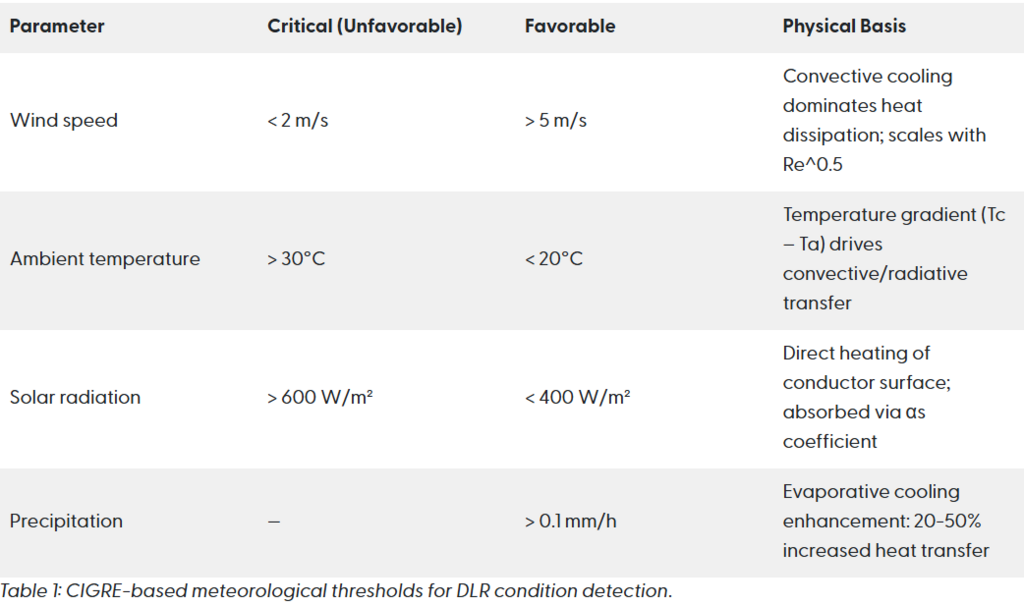
The detection system produces an operational score that indicates favorable or unfavorable situations. This scoring approach allows grid operators to anticipate risks and adapt the capacity of their transmission lines.
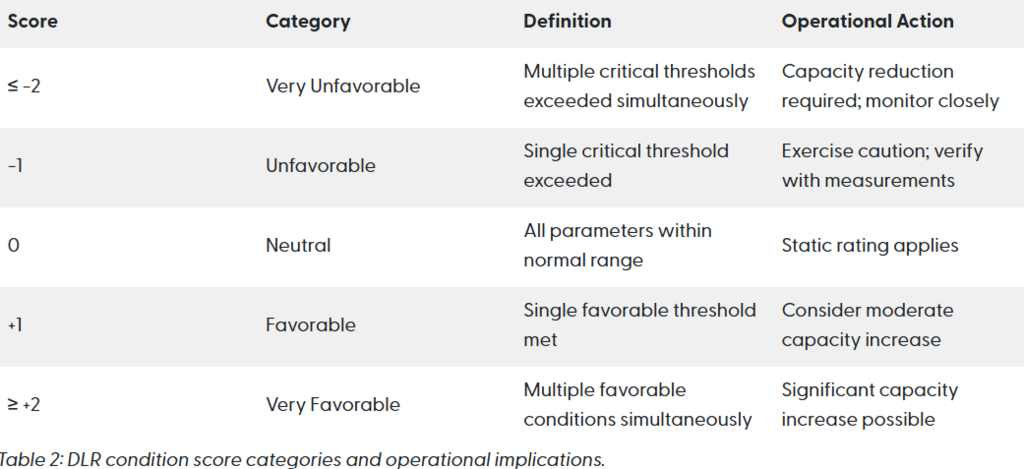
An added value of this pilot service is the integration of multi-scale numerical weather prediction (NWP). The service combines forecasts from continental to local scales to support different operational time horizons and decision needs. Forecast variables are translated into the projected DLR condition score, allowing operators to anticipate upcoming operating conditions.
Initial results in Belgium and Austria highlight the strong potential of this pilot service. Analyses conducted with transmission system operators such as Elia and Austrian Power Grid demonstrate significant spatial and temporal variability in line capacity.
For example, in Belgium, favorable wind conditions led to average capacity increases of up to 170% compared to static ratings. The service also enables detailed identification of bottleneck segments along transmission corridors, supporting targeted monitoring and infrastructure planning.
Example Belgium
Detailed analysis was performed for Elia’s Quaregnon-Trivieres 150kV transmission line in Belgium using DestinE Extremes hectometric data (~500 m resolution) on 12 February 2026 for a 48-hour forecast period.
For Elia’s Quaregnon–Trivières 150 kV line, high resolution DestinE data revealed predominantly favorable conditions:
The CIGRE model estimated a mean ampacity of 2159 A, a 170% increase over the static rating of 800 A.
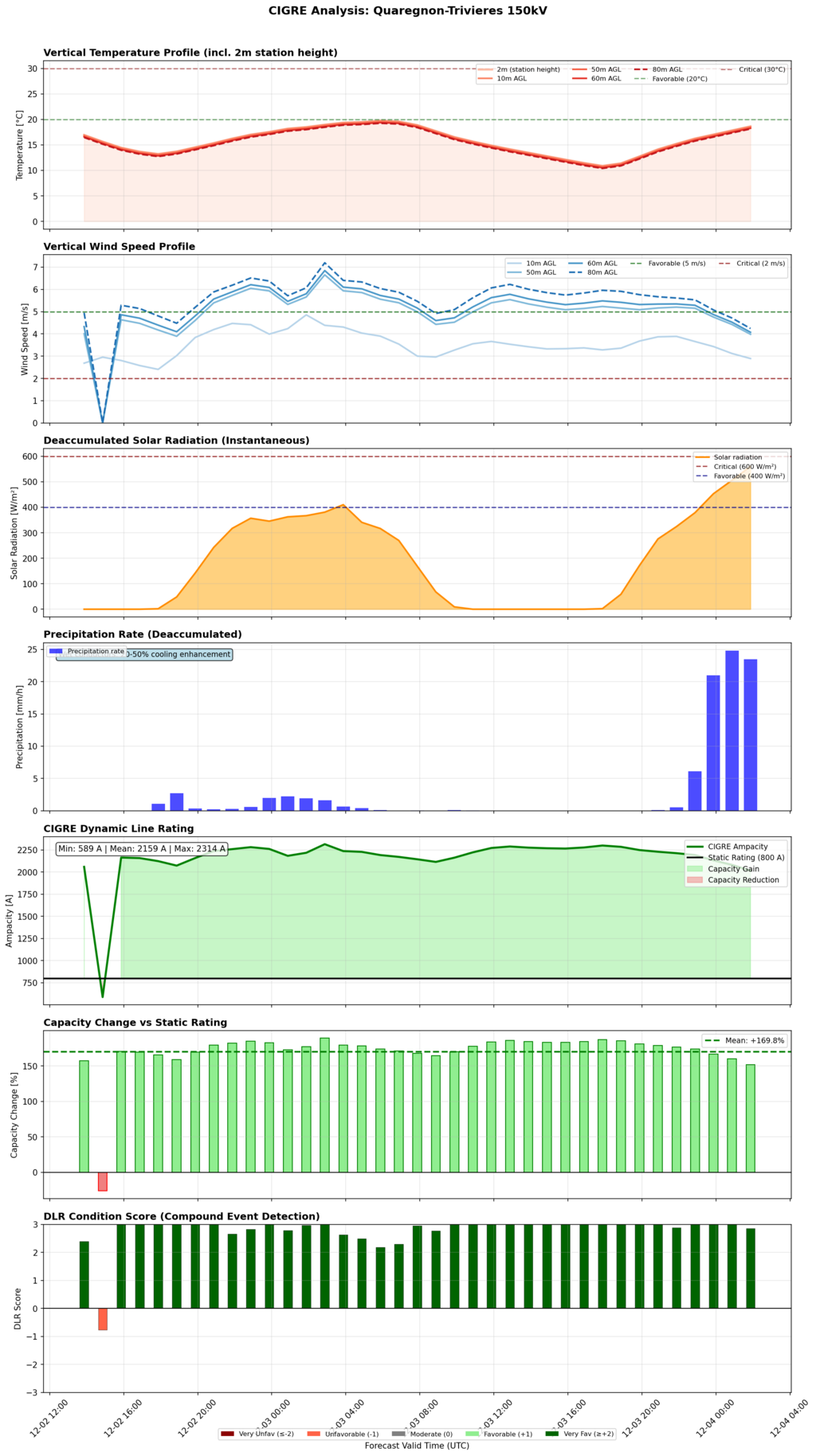
Figure 1: Temporal DLR analysis for the Belgian segment 380 kV corridor. Panels show meteorological parameters at conductor height (60 m AGL) and CIGRE ampacity versus 1200 A static rating.
An important feature of the pilot service is its ability to identify corridor bottlenecks. Even if most spans show high ampacity, a single unfavorable segment can limit the entire line.
In the Belgian case study:
Despite favorable conditions elsewhere reaching 2300+ A, the entire corridor capacity is constrained by this single segment—demonstrating the operational principle that a transmission line’s effective rating equals its weakest link. This spatial granularity enables TSOs to identify specific infrastructure where targeted measurements or localized weather stations would provide the greatest operational benefit.
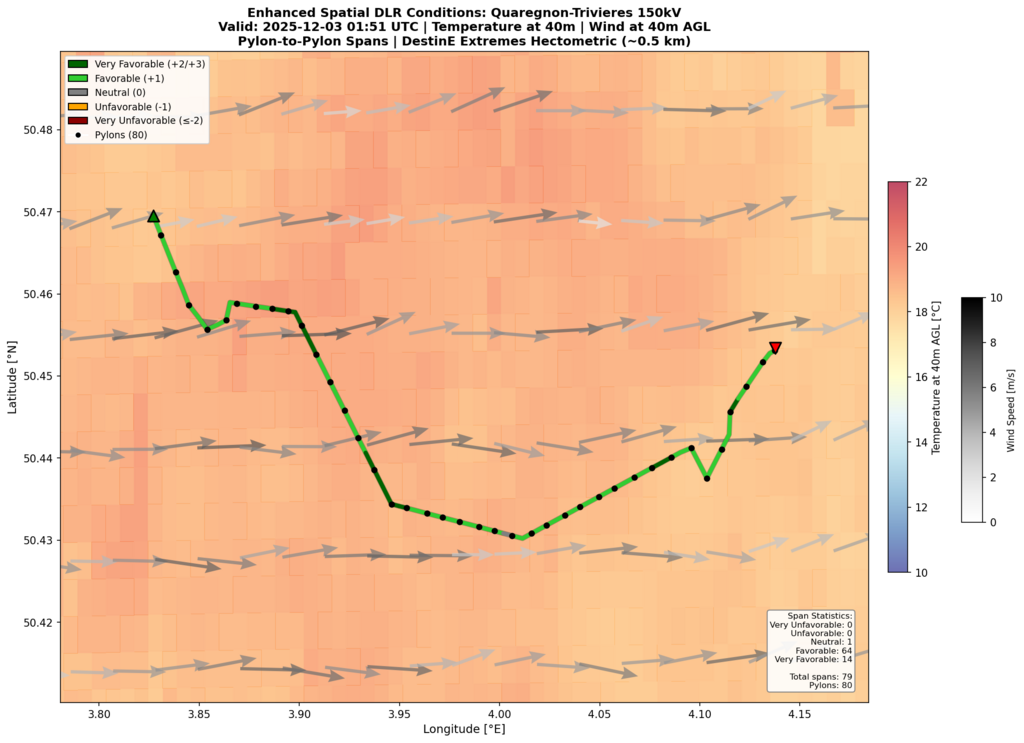
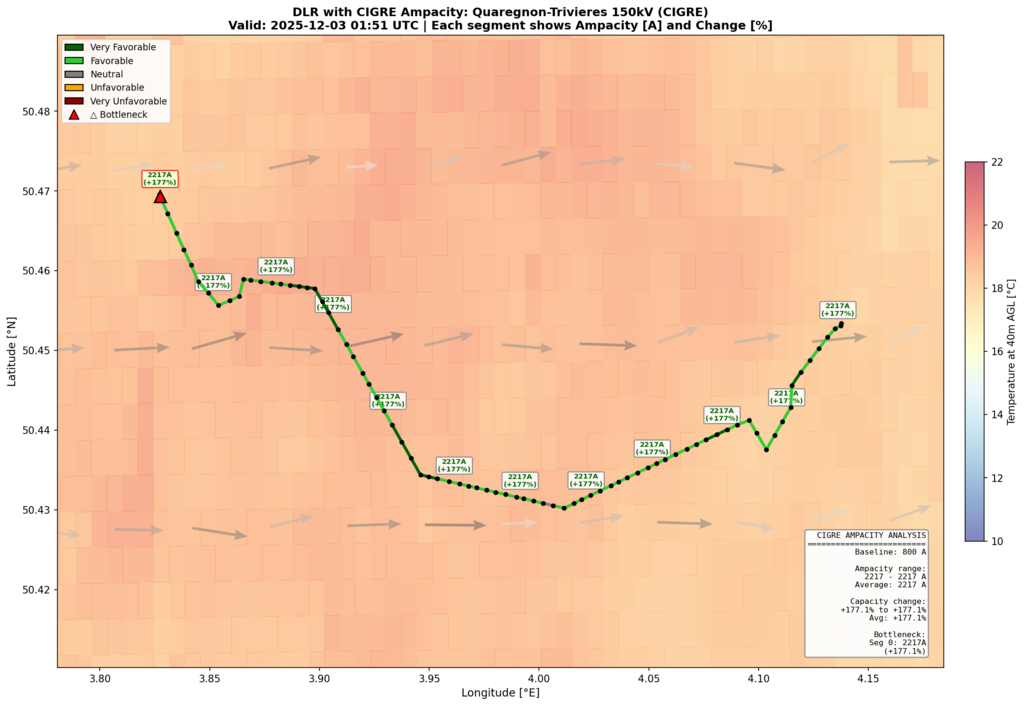
Figure 2: Spatial DLR conditions along the Quaregnon-Trivieres corridor at [timestep). Left: Temperature field with line geometry overlay. Center: Wind vectors at conductor height. Right: Per-segment DLR classification with bottleneck identification (red triangle marks limiting segment).
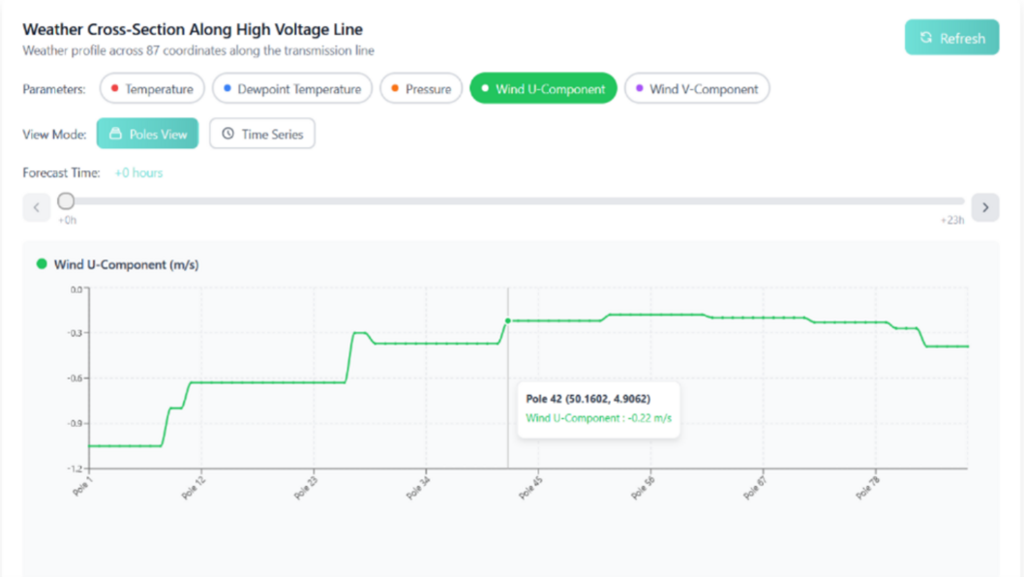
A web application has been developed to ensure practical usability. Users can upload transmission line coordinates, analyse temporal weather variability along these routes and obtain dynamic capacity estimates. The API enables automated integration of forecasts and indicators into existing operational systems. The application will be publicly available through the DestinE Platform, making it broadly accessible to researchers, decision-makers, and other stakeholders interested in high-resolution environmental data.
Dynamic Line Rating has the potential to increase grid flexibility, support renewable integration and reduce congestion. The pilot service demonstrates how digital twins and high-resolution forecasts can make this approach operational.
Future developments will focus on probabilistic forecasting, uncertainty quantification and machine learning, supporting wider deployment and contributing to a more resilient and efficient European energy system.