27/01/2026
Traditional machine learning is powerful, but a lot of tasks were still a nightmare to automate. Things like competitor analysis that requires continuous monitoring, document workflows that demand contextual understanding, customer interactions that need intelligent decision-making, and many more.
Agentic AI addresses these challenges directly. These systems pursue goals autonomously by breaking down tasks, selecting appropriate tools, and adapting as conditions change. What previously required months of data labeling and model training can now be prototyped and deployed in weeks, at a fraction of the cost.
Critical knowledge sits locked in documents and legacy systems. Agentic systems read, connect, and synthesize information across sources, generating new material when needed. Institutional knowledge becomes accessible and actionable, meaning it is no longer tied to individuals or static files. Teams spend less time searching and more time using the right information to get work done.
Competitive analysis is typically periodic, manual, and outdated by the time it reaches decision-makers. Agentic systems continuously monitor competitors, pricing, and market signals, summarizing changes and surfacing risks in real time. Organizations shift from reactive quarterly reports to continuous strategic awareness.
Support teams rely on scripted workflows and local knowledge bases. Agentic systems can supercharge these workflows, by maintaining context across conversations, reason about intent, escalate when needed, and improve from every interaction.
Teams waste time coordinating across tools, chasing approvals, and bridging process gaps manually. Agentic systems can help by serving the correct data where needed and execute time consuming dynamic workflows. Organizations reduce operational drag while continuously optimizing how work gets done.
Understanding where agentic AI doesn't fit is just as important as recognizing its strengths. We advise caution or alternative approaches in several scenarios:
When millisecond-level response times are critical and the logic is entirely deterministic, traditional programming approaches remain superior.
Keep it simple. Basic create, read, update, and delete operations don't benefit from the complexity and overhead of agentic systems.
While agentic systems can be designed with transparency in mind, applications where every decision must be fully traceable and explainable may require more traditional rule-based or symbolic AI approaches.
Although agentic AI can assist with data labeling to build more efficient traditional machine learning models, high-throughput, low-latency applications may still require optimized conventional architectures to keep the costs down.
The key is selecting the right tool for the job. Different use cases, existing technology stacks, and regulatory requirements demand different solutions.
The timing for agentic AI is not arbitrary:
GPT-5, Claude, Gemini and other large language models can now reason reliably enough to be trusted with consequential tasks.
RAG systems, vector databases, orchestration frameworks, ... The infrastructure needed to build production-grade agentic systems is now readily available.
While many organizations are still exploring, others are deploying agents that compound their competitive advantage every day.
Agentic AI is powerful, but it's not plug-and-play yet. Moving from an exciting prototype to a reliable production system requires managing several critical aspects:
Production agents need prompt versioning with rollback capabilities, comprehensive tracing of agent conversations and reasoning chains, and continuous evaluation frameworks. Understanding what agents are doing and why, is essential for debugging, improvement, and maintaining team confidence in the system.
Response times, interface design, and feedback mechanisms determine adoption. Users need clear indications of agent activity, reasonable waiting times, and intuitive ways to guide or override agent decisions when necessary.
Authentication, authorization, IP throttling, and protection against prompt injection attacks form the security foundation. Additionally, we need to ensure that agent behavior meets regulatory requirements, respects data privacy boundaries, and provides human in the loop for critical decisions.
Data quality directly impacts agent reliability: quality in, quality out. Managing context drift in long-running conversations, designing effective multi agent workflows, and structuring tool interfaces properly all determine whether the system scales reliably under real-world conditions.
This is where PropheSea's delivery framework comes into play. Working alongside your teams, we ensure that agentic AI systems move from concept to production with appropriate guardrails and governance. Our approach addresses each critical phase systematically:
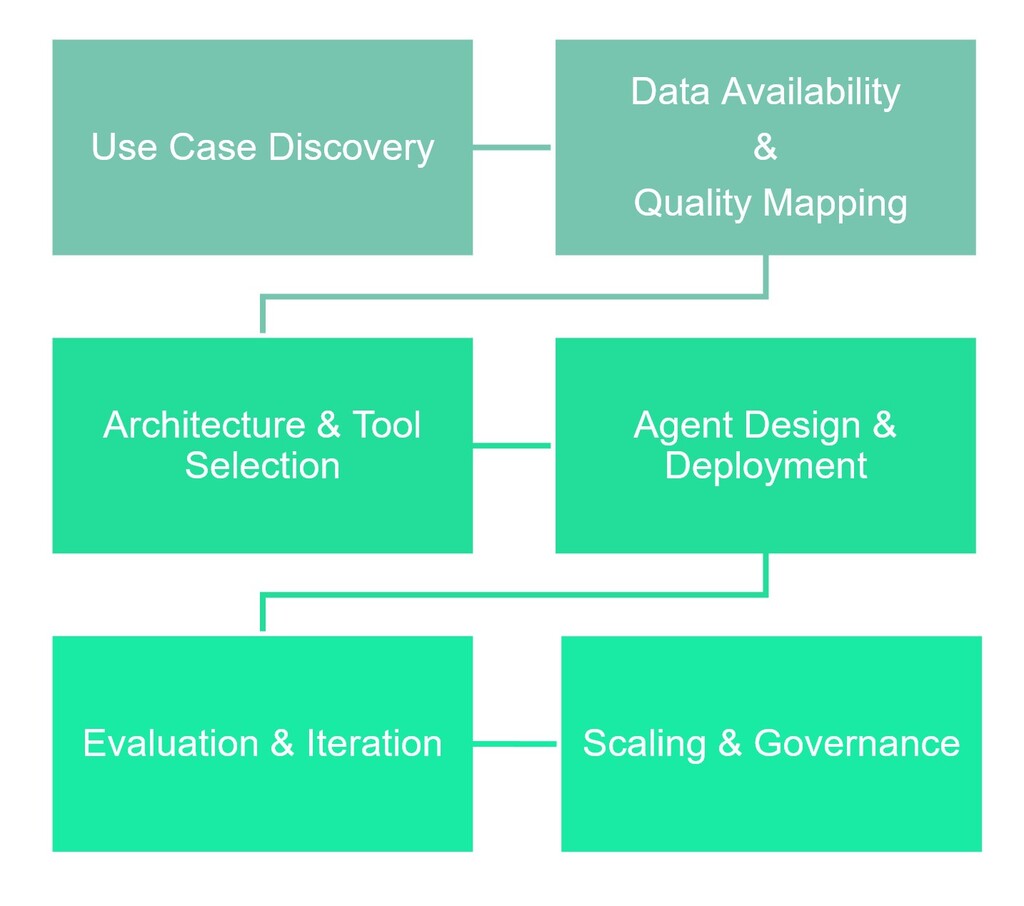
We work with you to understand your business objectives and define clear success criteria. Not every problem should be solved with agents. We help identify where agentic AI delivers genuine ROI.
Determining what the agent knows, remembers, and can access is critical. We assess your data landscape and design appropriate retrieval strategies, from RAG (Retrieval-Augmented Generation) to more complex search methods and structured memory systems.
Different constraints demand different choices. Cloud versus on-premises deployment, open-source versus managed models, deterministic pipelines versus autonomous agents. We help you navigate these decisions and make informed tradeoffs based on your specific requirements around security, compliance, and integration.
We define agent roles, design tool interfaces, craft effective prompts, and implement guardrails to ensure reliable and safe operation. This includes versioning and traceability of prompts and agent behavior.
Success metrics go beyond subjective assessments. We establish quantitative measures for accuracy, latency, cost, and failure modes, enabling continuous improvement through structured feedback loops and cost optimization.
Production systems require ongoing monitoring, compliance verification, and long-term maintenance. We work with you to implement frameworks for tracking agent behavior over time and adapting to evolving requirements. You're left with systems you understand and can evolve.
If you're considering agentic AI, the most valuable first step is not building, it's identifying the right problem and constraints.
We help organizations do exactly that.
Whether you have a specific use case in mind or want to explore what's possible, we'd be happy to discuss your challenges and determine whether agentic AI is the right solution.
Contact us to schedule a use case discovery workshop, learn more about our delivery framework, or discuss how we can work alongside your team to move from experimentation to production-ready agentic systems. We look forward to hearing from you.
We entered a new digital era. Software development is becoming more accessible. More is possible with less effort. Efficiency gains are compounding across industries.
Agentic AI represents not just an incremental improvement but a fundamental shift in how we approach problem-solving with technology.
At PropheSea, we've consistently been at the forefront of combining domain expertise with cutting-edge AI approaches, from physics-informed neural networks for thermal production modeling to AI-enhanced weather forecasting for grid optimization. Agentic AI is the next chapter in this journey, and we're excited to help organizations navigate this transformation thoughtfully and effectively.